
How to Find and Use a Top-Rated SEO Keyword Position Tool for Your Website
A modern seo keyword position tool must track more than just "blue links." In the current landscape, look for features that monitor AI Overviews , local map grids, and mobile-specific SERPs. For most users, Ahrefs or Semrush provide the most comprehensive data, while specialized tools like Keyword.com offer high-frequency updates and AI search visibility tracking that is essential for modern AEO (AI Engine Optimization).
The Problem with Manual Rank Checking
In the early days of search, you could simply type a keyword into Google and see where you stood. By 2026, this method has become largely obsolete due to extreme personalization. When you check your own rankings manually, you are seeing a version of the web that is heavily filtered by your IP address, search history, device fingerprint, and whether or not you are logged into a Google account.
According to research on neutrality and personalization , Google uses hundreds of signals to tailor results to the individual. This means your site might appear at position #1 for you, but position #12 for a potential customer three towns away. Even using "Incognito Mode" does not provide a truly neutral view, as Google still utilizes your IP location and browser metadata to serve localized results.
10 Best SEO Keyword Position Tools for Every Budget and Need
Selecting the right tool depends on your specific goals—whether you are a solo blogger, a local business owner, or an agency managing hundreds of clients. Below is a curated list of tools that rank among the top options available today.
1. Ahrefs Rank Tracker
Paid Ahrefs is widely regarded as one of the strongest all-in-one SEO platforms. Its rank tracker provides daily or weekly updates and integrates deeply with its massive database of over 500 million keywords (Source: Ahrefs) . It is particularly useful for seeing how your rankings have evolved since 2015, providing historical context that few competitors match.
2. Semrush Position Tracking
Paid Semrush stands out for its daily data refreshes and its ability to track rankings across multiple devices and locations simultaneously. It is a popular choice for competitive analysis, allowing you to benchmark your visibility against up to five competitors in a single view (Source: Semrush) .
3. Keyword.com
Agency For those who need extreme accuracy, Keyword.com is a top-tier option. It specializes in "human-level" verification, ensuring that the rank reported by the tool matches what a real user sees. It has also recently integrated AI Search Visibility tracking, which is essential for monitoring mentions in LLMs like ChatGPT and Perplexity.
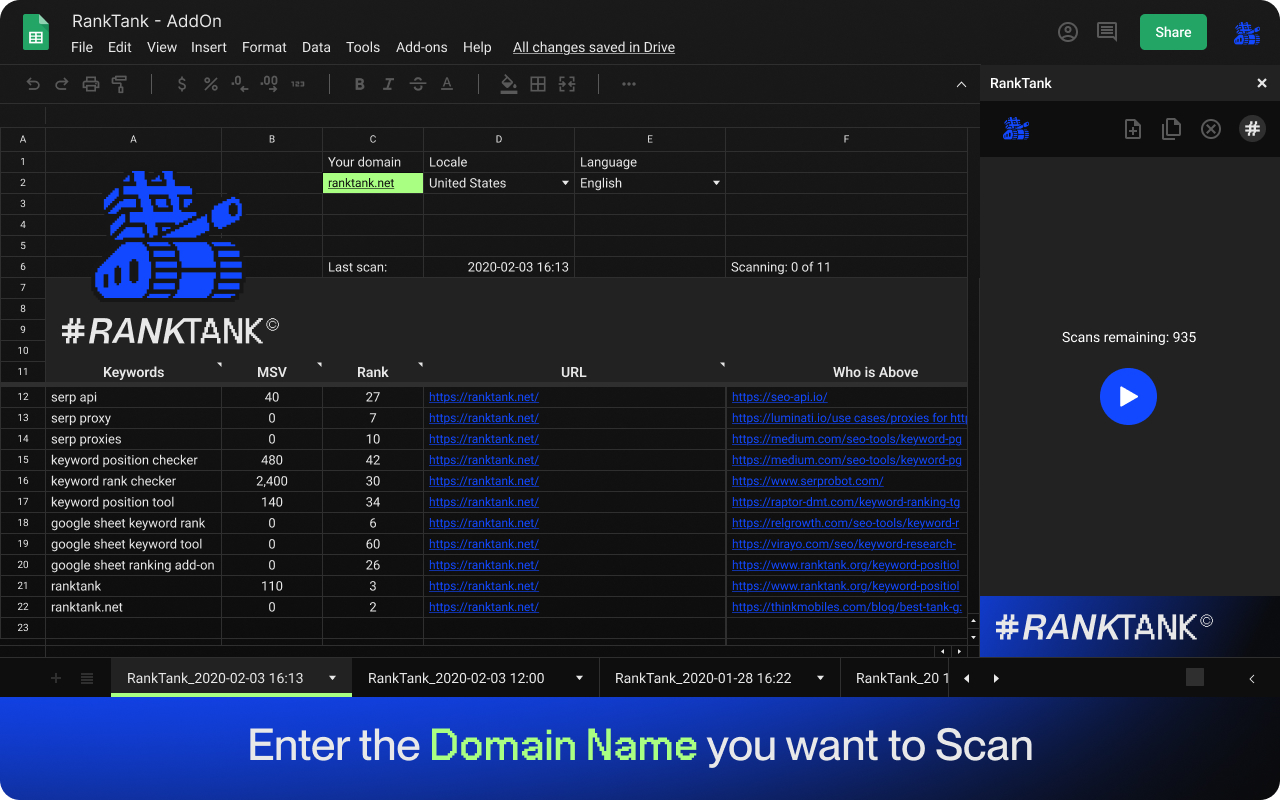
Image source: Google Workspace
4. Seobility Ranking Checker
Free/Paid Seobility offers a highly accessible entry point for small business owners. Their free tool allows for quick, neutral SERP checks without the need for a complex setup. It provides a clean interface that focuses on the core metrics: position, search volume, and competition level.
5. LocalFalcon
Local If you manage a physical storefront, LocalFalcon is a significant advancement over traditional trackers. Instead of checking your rank from a single point, it creates a "grid" over a map, showing how your ranking changes as a user moves just a few blocks away from your location.
6. SEO PowerSuite (Rank Tracker)
Desktop For those who prefer desktop software over SaaS, SEO PowerSuite offers a highly capable tool that allows for unlimited keyword tracking without monthly subscription fees. It is particularly strong for deep-dive technical audits and bulk keyword checks (Source: SEO PowerSuite) .
7. SEOptimer
Affordable SEOptimer is a top choice for freelancers who need white-label reporting. It offers a balance of keyword tracking and on-page auditing, making it a comprehensive choice for client presentations.
8. SmallSEOTools
Free This is a simple, no-frills tool for quick checks. While it lacks the deep analytics of Ahrefs, it is one of the most popular choices for immediate, one-off keyword position lookups.
9. Keysearch
Budget Keysearch is often cited as a top-rated budget alternative to the "big two" (Ahrefs/Semrush). It provides solid rank tracking and keyword clustering features that help users identify LSI opportunities (Source: Keysearch) .
10. Google Search Console (GSC)
Free While not a traditional "tracker" that you can query in real-time, GSC is the "ground truth" for SEO. It shows the average position of your keywords based on actual user impressions, making it an essential cross-reference for any paid tool.
| Tool Name | Free Version? | AI Tracking? | Local Grid? | Best For |
|---|---|---|---|---|
| Ahrefs | Limited | Yes | No | All-in-one Data |
| Keyword.com | Trial | Yes | Yes | Agency Accuracy |
| Seobility | Yes | No | No | Quick Audits |
| LocalFalcon | No | No | Yes | Local Businesses |
| Semrush | Trial | Yes | Yes | Daily Monitoring |
How to Track Your Visibility in AI Overviews and LLM Responses
The SEO landscape in 2026 has shifted from "Search Engine Optimization" to "AI Engine Optimization" (AEO). Google’s AI Overviews (formerly SGE) and standalone LLMs like ChatGPT and Perplexity are now major sources of traffic. A traditional seo keyword position tool that only tracks the "top 10 blue links" is missing a significant portion of the user journey.
Modern tools now include "AI Search Visibility" metrics. This doesn't just track if you are #1; it tracks if your brand is mentioned as a source in an AI-generated summary. Even if your website is in position #7 organically, you might be the primary source for the AI Overview at the top of the page. This is a top-tier opportunity for sites with high-quality, structured data that AI models can easily parse.
Why Your Tool Shows One Rank While Your Browser Shows Another
One of the most common frustrations for SEOs is the "API vs. Human" discrepancy. You might see your tool reporting a rank of #5, but when you check manually, you are at #2. According to community insights from the Local Search Forum , this happens because tools often use "headless browsers" or APIs that Google treats differently than a real human browser with a cookie history.
Google may serve a "simplified" SERP to automated queries to save resources, or it may apply different localization filters. To find the "ground truth," you should always cross-reference your tool's data with Google Search Console's Average Position . While GSC data is delayed by 2-3 days, it represents what real users actually clicked on, making it a highly reliable benchmark for performance.
How to Use Local Grid Tracking to Dominate Your City
For service-area businesses like plumbers, lawyers, or restaurants, a single ranking number is often misleading. You might rank #1 when someone searches from your front door, but drop to #10 when they search from three blocks away. This is known as the "proximity factor."
Grid Tracking (offered by tools like LocalFalcon or Keyword.com) solves this by visualizing your rank across a map. It places a grid of pins over your city and checks the rank at each coordinate. This allows you to see exactly where your "visibility radius" ends. If you see a sea of green pins near your office but red pins to the North, you know you need to build more localized content or backlinks targeting that specific neighborhood.
The Young Site Strategy for Finding Easy Ranking Wins
An advanced technique for 2026 involves using your seo keyword position tool to find "weak" SERPs. Instead of just looking for high-volume keywords, filter your competitor list to find keywords where websites under 2 years old are ranking in the top 10.
This is a notably innovative strategy because it signals that Google is prioritizing "freshness" or specific on-page signals over long-term domain authority. If a new site with a low Domain Rating (DR) can rank for a term, it means the keyword is "winnable" for you too, regardless of your backlink profile. This is one of the most effective ways to find low-hanging fruit for new domains (Source: Detailed) .
What to Do After Your Keyword Position Changes
Tracking is only half the battle. The real value comes from the "Now What?" strategic framework. Depending on where your keyword currently sits, your optimization strategy should change.
Frequently Asked Questions
Log into your GSC account, go to the "Performance" report, and ensure the "Average Position" box is checked. You can then filter by specific queries or pages to see your ranking trends over the last 16 months. This is widely considered one of the most accurate free methods available.
Google uses mobile-first indexing, but SERP layouts differ significantly between devices. Mobile results often feature more local packs, images, and shorter snippets. Additionally, user behavior varies by device, leading Google to adjust rankings to better suit the intent of a mobile vs. desktop user.
For high-stakes, "money" keywords that drive significant revenue, daily tracking is recommended. For general blog content or long-tail terms, weekly or even monthly tracking is usually sufficient to identify long-term trends without getting bogged down in daily fluctuations.
Yes, professional tools like Keyword.com and Semrush allow you to specify a city or even a specific zip code. This is essential for service-area businesses, as rankings can vary significantly even within the same metropolitan area.
For a brand-new site, appearing anywhere in the top 100 is a positive sign that Google has indexed and categorized your content. The goal is to move into the top 20 within 3-6 months, and eventually the top 10 as your domain authority grows.
Final Thoughts on Mastering Your Search Visibility
Tracking your keyword positions is no longer about chasing a single number; it is about understanding your overall visibility in an increasingly complex search ecosystem. By using a top-tier seo keyword position tool , you can move beyond manual guesswork and make data-driven decisions.
- Stop manual checking ; it is biased by your personal search history and location.
- Prioritize AI Overviews ; ensure your tool tracks mentions in LLMs and Google's AI summaries.
- Use Local Grid tracking if you have a physical location to see your true reach.
- Cross-reference with GSC to find the "ground truth" of your average positions.
- Act on "Striking Distance" keywords (Pos 11-20) first for the fastest ranking gains.
- Monitor mobile vs. desktop discrepancies to ensure a consistent user experience.
Start by auditing your top 10 most important keywords today to see how they appear in AI Overviews versus traditional organic results.

How to Check Your SEO Keyword Rankings for Free and Improve Your Search Visibility
Check Google rankings for free. Compare top SEO keyword rank checkers for mobile, desktop, and local accuracy to improve search visibility.


How to Use Google AI Mode to Get Better Search Results with Gemini
Learn how to use Google AI Mode, trigger Deep Search, and fix Workspace issues. Master Gemini-powered search with our expert tips for 2026.


How to Create and Manage a Google Business Profile That Ranks
Create, verify, and optimize your Google Business Profile to rank higher in local search and attract more customers. Expert tips for 2026 success.